Mobile Forklift Tire Service: Press-On vs Pneumatic, Replaced at Your Yard
A forklift with a chunked tire doesn't drive to a tire shop. It gets parked, and everything it was supposed to move sits on the dock. Here's how to tell press-on from pneumatic, when forklift tires are done, and what it costs to have them changed at your yard.
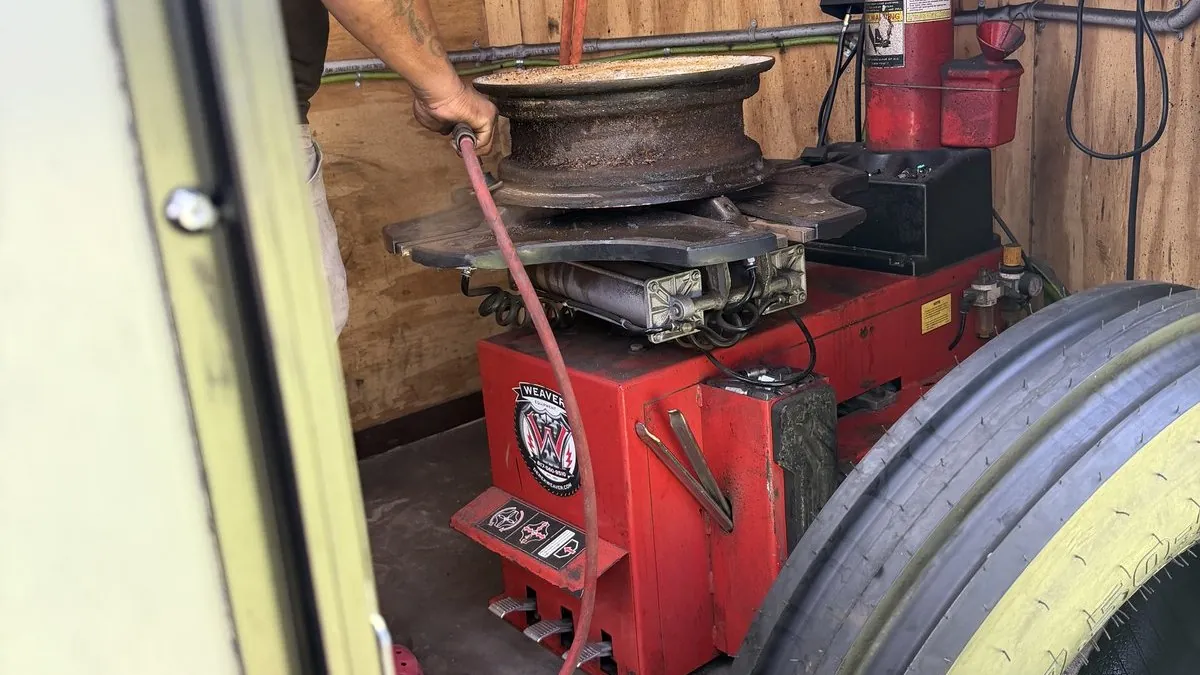
Quick answer: forklift tires come in two families. Press-on (cushion) tires are solid rubber bonded to a steel band and pressed onto a smooth steel wheel with a hydraulic press — they're built for smooth concrete floors indoors. Pneumatic tires, either air-filled or solid pneumatic, are built for outdoor yards, gravel and lumber lots, and mount on split or multi-piece rims like a truck tire. Replace either kind when the rubber reaches the wear line, and replace them in pairs on the same axle. Our published forklift mount is $50 per tire, on commercial labor of $105 an hour with a 2-hour minimum on weekdays — so a pair on a weekday runs $310 plus the tires.
We come from a transportation background, so we know how this goes. A forklift with a chunked or flat tire doesn't get driven anywhere — it gets parked, and the trailers it was supposed to unload sit at the dock while somebody figures out who to call. A lift truck isn't street-legal and doesn't fit in the back of a pickup, so "take it to the tire shop" means a flatbed, a lost day and a second forklift you probably don't have. That's the whole case for bringing the tire shop to the yard, whether the yard is a warehouse off the I-75 corridor, a lumber lot in Belleview or a nursery out past Dunnellon.
Press-on vs pneumatic: which one is on your forklift
The tire type isn't a preference you get to change on a whim — it's built into the truck. Forklifts are made either as cushion-tire trucks or pneumatic-tire trucks, with different wheels, frames and ground clearance. Here's what each type is and where it belongs:
| Tire type | What it is | Where it works | How it mounts |
|---|---|---|---|
| Press-on (cushion) | Solid rubber bonded to a steel band. Low profile, no air. | Smooth concrete — warehouse floors, docks, indoor plants | Pressed onto a smooth steel wheel with a hydraulic press |
| Air pneumatic | Air-filled, deep tread, like a small truck tire | Outdoor yards, gravel, dirt, lumber lots, uneven ground | Mounted on a split or multi-piece rim, then inflated |
| Solid pneumatic | Solid rubber built in a pneumatic tire's shape. Can't go flat. | Outdoor yards full of nails, scrap, glass or rebar | Fits the same rim as an air pneumatic; usually needs a press or a dedicated mounting tool |
A general guide. Your truck's data plate and the size molded on the tire tell you exactly what it runs — when in doubt, send us a photo of both.
The trade-offs are simple. Press-ons are cheap, compact and last a long time on smooth concrete, but they ride hard and they hate gravel, potholes and wet grass. Air pneumatics ride softer and grip outdoors, but they can pick up a nail like any other tire. Solid pneumatics are the middle ground for nasty yards — no flats, ever, at the cost of a stiffer ride and a heavier tire. What you can't do is bolt pneumatic tires onto a cushion-tire forklift. If your operation has moved outdoors, the answer is a different truck, not different tires.
How to tell which tires you've got
Before anybody quotes you a forklift tire, they need the size and the type. Thirty seconds at the truck gets you both:
- Three numbers means press-on. Cushion tire sizes read like 21x7x15: outside diameter, width, then the inside diameter of the steel band, all in inches.
- A dash means pneumatic. Pneumatic sizes read like 6.50-10 or 28x9-15: the number after the dash is the rim diameter. Solid pneumatics use the same sizes as the air tires they replace.
- Look at the wheel. A smooth steel band with the rubber bonded right to it is a press-on. A rim with bolts around it, or a lock ring, is a split or multi-piece rim — that's pneumatic.
- Check the data plate. The truck's capacity plate lists the tire type it was rated with. Capacity ratings assume the right tires — a different tire can change what the truck can safely lift.
- Still not sure? Text us a photo of the sidewall and one of the wheel. We'll read it for you.
When forklift tires need replacing
Forklift tires don't fail the way car tires do. There's no tread-depth law and no penny test, and most of them never go flat. They wear down, chunk out, and come apart from the steel. Here's what tells you they're done:
- Rubber at the wear line. Most solid tires have a wear line molded into the sidewall. When the tread surface wears down to it, the tire is done — even if it still looks like there's rubber left.
- Chunking. Pieces of rubber torn out of the tread, usually from dock plates, debris or sharp turns on rough concrete. A few nicks are normal. Chunks missing from the face are not.
- Flat spots and vibration. A press-on that's been skidded or sat loaded for a long time can wear flat in one place. The operator feels it as a thump, and so does the load.
- Separation or cracking. Rubber pulling away from the steel band on a press-on, or cracks in the sidewall of a pneumatic, mean replace now. Florida heat and outdoor storage speed the cracking up.
- Pneumatics losing air or showing cord. Low pressure on an air pneumatic changes the truck's stance and stability. Cuts to the cord, or a sidewall puncture, end the tire.
- Mismatched pairs. One new tire next to one worn tire on the same axle — the next section explains why that's a problem.
Why worn forklift tires are a safety problem, not a comfort problem
A forklift has no suspension. The tires are the suspension, and they're also what the truck's stability is built around. When the rubber wears down, the truck sits lower, the mast tilts slightly differently, and every bump in the floor goes straight into the load and the operator's back. Worn tires also mean longer stopping distances and less clearance over dock plates.
Replace forklift tires in pairs on the same axle. A new tire next to a worn one leaves the truck leaning to one side — and on a forklift, a lean at floor level is a bigger lean at the top of the mast, with a load on it.
That's also why we don't recommend running a tire past its wear line to squeeze out another month. The tire is the cheapest part of the truck and the load is usually the most expensive thing on it. If your forklifts work outside in a Marion County summer — sitting on blacktop, or parked in the sun between shifts — check them more often than the indoor trucks. Heat is hard on rubber in every form.
Split rims: the part of this job that hurts people
Most pneumatic forklift tires live on split or multi-piece rims — two halves bolted together, or a rim held by a lock ring. Those rims hold a lot of energy when the tire is aired up. If the bolts are loosened or a lock ring is disturbed with air still in the tire, the rim can come apart with enough force to kill someone. It's one of the reasons OSHA has its own rule for servicing multi-piece rim wheels.
The safe sequence isn't complicated, but it isn't optional either: the tire gets fully deflated before anything on the rim is touched, the rim parts get checked for cracks and damage, and the tire gets inflated in a safety cage or with a restraint — never with a person standing over it. If somebody on your crew has been doing this with a floor jack and an air chuck, that's the conversation to have before anything else.
On an air pneumatic with a nail in the tread, a repair is sometimes possible — the same rules apply as on a truck tire, and we cover them in when a tire can be patched, and when a sidewall means no. Yards that keep picking up punctures often switch to solid pneumatics on the same rims and never think about flats again.
What we do at your yard
We bring the truck, the trailer and the tools to wherever the forklift is parked — the dock, the yard, the job site or the back of the nursery. We lift the truck safely, pull the wheels, and mount the new tires on site. Air pneumatic and solid pneumatic tires are the bread and butter of this work. Press-ons are a press job: call us with the size off the tire and we'll tell you straight, before anybody rolls, whether yours is a yard job for us or a job for a shop with a press. You won't find that out after you've paid for a trip.
Because we run 24 hours a day, weekends and holidays included, forklift work fits around your shifts instead of the other way around. Have us swap tires before first shift or after the last one, and the truck is never down during the hours that matter. And if you run more than one or two lift trucks, ask about a fleet account — scheduled tire checks, agreed pricing and one invoice. That's the same setup behind our commercial and fleet tire service in Ocala, which covers the semis, box trucks and trailers that load at your dock too.
The same trailer handles the equipment that doesn't live in a warehouse. If your operation also runs tractors, mowers or utility vehicles, we do ATV, mower and farm equipment tires in Marion County on the same visit.
What mobile forklift tire service costs in Ocala
Our pricing is public, so here's the whole number. Forklift work is billed on our commercial rate card: $105 an hour with a 2-hour minimum on weekdays from 8 to 5, or $125 an hour with the same minimum nights, weekends and holidays. Each forklift tire mount is $50 on top of that. Here's what that looks like for a pair and for a full set, assuming the job fits inside the 2-hour minimum:
| Mobile forklift tire job | Weekdays 8–5 | Nights, weekends, holidays |
|---|---|---|
| Commercial labor (2-hour minimum) | $210 | $250 |
| Mount ×2 at $50 | $100 | $100 |
| A pair: labor + mounts | $310 | $350 |
| Mount ×4 at $50 | $200 | $200 |
| All four: labor + mounts | $410 | $450 |
| Tires | Quoted by size and type | Quoted by size and type |
Jobs that run past 2 hours bill at the same hourly rate. Fleet accounts get agreed pricing and one invoice.
The tires are priced by size and type — a solid pneumatic costs more than the air tire it replaces, and press-ons vary a lot by size — so we quote them on the phone once we know what's on the truck. Compare the total against the alternative honestly: a flatbed to haul the forklift out, the day it's gone, and whatever didn't get loaded while it was. For most yards, the math isn't close.
And the honest part: if your tires still have life above the wear line, we'll tell you to run them and check back. We'd rather earn the call when they're actually done than sell you a set you didn't need.
Forklift down? Get it rolling before first shift.
Text us a photo of the size on the tire and the wheel it’s on. We’ll tell you straight whether it’s a yard job and quote it on the phone — $50 a mount plus commercial labor, 24/7 across Marion, Lake and Sumter counties.
Call (352) 470-4410Quick answers
What is the difference between press-on and pneumatic forklift tires?
Press-on (cushion) tires are solid rubber bonded to a steel band and pressed onto a smooth steel wheel — they’re made for smooth indoor concrete. Pneumatic tires are built like small truck tires for outdoor yards and rough ground, and mount on split or multi-piece rims. Solid pneumatics are solid rubber in a pneumatic shape, so they fit the same rims and can’t go flat.
Can I put pneumatic tires on a cushion-tire forklift?
No. Cushion-tire and pneumatic-tire forklifts are built differently — different wheels, frames and ground clearance — so you can’t swap one tire type for the other. If your work has moved outdoors, you need a pneumatic-tire truck. Within the pneumatic family, you can switch between air-filled and solid pneumatic on the same rims.
How do I know when forklift tires need replacing?
Replace them when the rubber reaches the wear line molded into the sidewall, or sooner if you see chunks torn out of the tread, flat spots, rubber separating from the steel band, sidewall cracks, or an air pneumatic that won’t hold pressure. Forklifts have no suspension, so worn tires affect stability, not just ride.
Should forklift tires be replaced in pairs?
Yes, on the same axle. A new tire next to a worn one leaves the truck leaning slightly to one side, and that lean is magnified at the top of the mast when it’s carrying a load. Replace both tires on the axle at the same time.
Do you come to the warehouse or yard to change forklift tires?
Yes. We come to the dock, yard, job site or nursery anywhere in Marion, Lake and Sumter counties, 24/7. Air and solid pneumatic tires are mounted on site. For press-on tires, call with the size and we’ll tell you before we roll whether it’s a yard job for us or a job for a shop with a press.
How much does mobile forklift tire service cost in Ocala?
Forklift work is billed at our commercial rate: $105 an hour with a 2-hour minimum on weekdays 8 to 5, or $125 an hour with the same minimum nights, weekends and holidays, plus $50 per forklift tire mount. A pair on a weekday is $310 for labor and mounts, and all four is $410, plus the tires, which we quote by size and type.
Can a flat forklift tire be repaired?
An air-filled pneumatic forklift tire with a puncture in the tread can sometimes be repaired, using the same rules as a truck tire. Sidewall damage, cuts to the cord, and solid tires that have chunked or separated can’t be repaired — they get replaced. If your yard keeps picking up flats, solid pneumatic tires on the same rims end the problem.
What we do about it
Commercial & Fleet Tire Service
A truck sitting at a tire shop is a truck that is not earning. We come to the yard, the job site, or the shoulder.
Learn more →ATV, Mower & Farm Tires
You can’t exactly drive a zero-turn to a tire shop. We do tires and tubes for ATVs, mowers, tractors and farm equipment — where the machine sits.
Learn more →Roadside Tire Service
Stranded on the shoulder is not the moment to start calling around. One number, any hour, and we come to you.
Learn more →Flat tire? We're already rolling.
Call or text (352) 470-4410 and tell us where you are. Most Ocala-area calls are handled the same day — often within the hour.